
Blog
What Actually Happens When A Customer Wants To Pay You In Bitcoin
An invoice is not a card swipe. Confirmation, refunds, books, and who holds the keys — before you say yes at the counter.
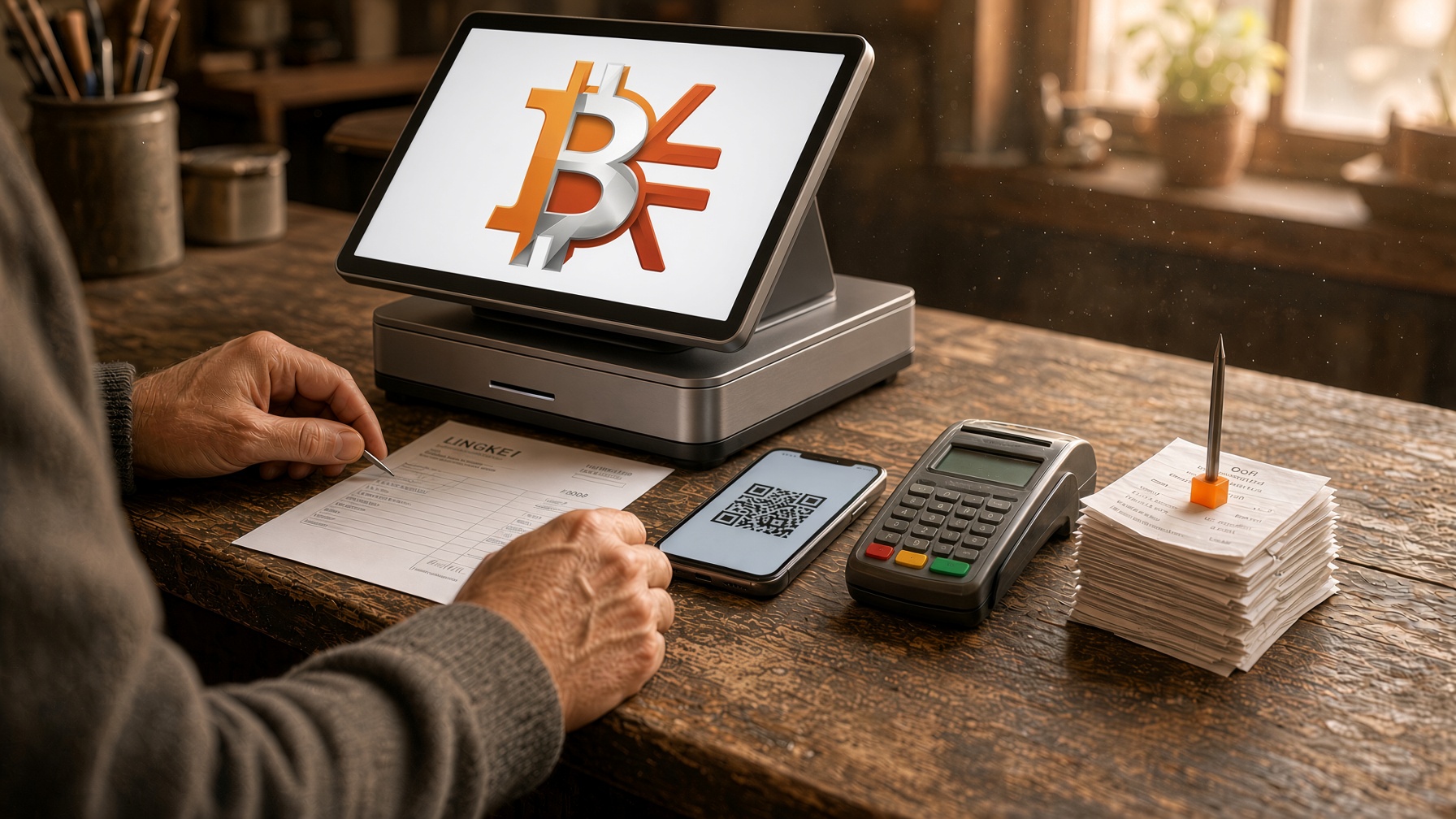
A customer asks if you take Bitcoin. That is not the same question as “do you take cards.”
Cards move through a network that can reverse a charge. Someone at a processor can freeze a batch. Someone at a bank can open a case. Bitcoin does none of that. The customer signs. The payment lands in a batch. Later batches pile on. There is no help desk that can unwind it because they had a change of heart in the parking lot.
Block9 is a Missouri technology company. We set up wallets and registers so your team can take that payment. We do not hold your keys or your funds. You sign. How you book it for tax is a conversation with your CPA, not with us.
Bitcoin’s 2008 paper describes money sent from one party to another without a bank in the middle. When Satoshi estimated storage, the paper treats new batches as arriving about every ten minutes. That is a target used for the math. It is not a promise that this sale clears in ten minutes. Some batches come faster. Some come slower. A congested afternoon is not a broken terminal. It is the clock the network actually runs on.
A card terminal beeps “approved.” Bitcoin does not. One confirmation means the payment landed in a batch. More batches on top of that one make a reversal harder. How long you wait is a shop rule, not a religion. A $40 counter sale and a $40,000 deposit are not the same risk. Write the rule when you are calm. Do not invent it at 4:55 p.m. with a line behind the register.
Card costs are a different machine. The Federal Reserve Bank of Kansas City publishes the piece that goes to the card issuer — interchange — from the networks’ own schedules. The August 2026 update is their table. It is not your merchant-account rate. Small-business guides often describe all-in processing, interchange plus assessments plus markup, in a band around 1.5% to 3.5% of the ticket, cheaper in person than online. Treat that band as a guide, not a Fed statistic.
There is more than one way a customer can pay you in this stack. If you treat them as the same thing, you will write the wrong invoice.
Bitcoin on the main chain is the slowest and the most public. Best when the amount is large and you want a record you can point at later. Worst when the ticket is a coffee and the customer is already halfway out the door.
Lightning was built so a small sale does not wait on those ten-minute batches. The 2016 summary from the people who designed it says payments “don’t need block confirmations, and are instant and atomic,” and that Lightning “can be used at retail point-of-sale terminals.” That is their wording for a payment on a channel that is already open. Opening a channel, or closing one, is a bitcoin transaction on the main chain. That waits on the same ~10-minute batches as any other on-chain payment — often more than one batch before you treat the channel as ready. Do not mix those clocks. Checkout is seconds if the pipe is already there. Standing the pipe up is bitcoin time. Someone on your side still has to keep it funded and watched.
sBTC is bitcoin represented 1-for-1 on Stacks so it can move in apps and contracts. It is not Lightning. It is not a card. Paying with sBTC the customer already holds is a Stacks transfer. That is seconds, not a ten-minute bitcoin batch. What is slow is the peg — turning main-chain bitcoin into sBTC, or sBTC back into main-chain bitcoin. Stacks docs put peg-in around three bitcoin batches and peg-out around six. A group of signers, not one company, has to agree on that peg. Stacks docs put that bar at 70%. Read their security model. It is not “no one in the middle.” It is also not the same as holding bitcoin on the main chain.
USDCx is the dollar rail on Stacks when the ticket should not move as bitcoin at all. Stacks Labs documents a USDC bridge between Ethereum and Stacks powered by Circle xReserve — issued USDC, not a third-party wrapper. Paying with USDCx they already hold is a Stacks transfer. That rides Nakamoto blocks. Seconds — same clock as sBTC they already hold. What is slow is the bridge: moving USDC from Ethereum onto Stacks. Public materials on that bridge cite roughly fifteen minutes and a 10 USDC minimum. Taking a dollar they already have is checkout. Waiting on the bridge is not. Issuing a dollar coin is a different job. We do not issue dollar coins, and we do not tell you whether you may.
You can take bitcoin without giving a processor the right to freeze the funds. You can also make a mess of it. One hot wallet on a phone. A backup phrase in email. No written refund rule. The “company wallet” that is also the owner’s personal wallet.
A clean setup is boring on purpose.
The business controls the receiving wallet. Day’s take lives in one place the closer can use. What you are not spending this week does not live on that phone. Most shops we sit with keep more than one person on the large balance. That is operations, not a legal rule we are handing you. Hardware is sold separately. Products shops actually open for that pattern include Asigna and Fordefi. Naming them is not a recommendation.
The invoice names the amount, where it goes, and which flavor — main-chain address, Lightning invoice that expires, sBTC request, or USDCx. A stale QR on the counter is how you take the wrong payment.
You write a confirmation rule. Small tickets can clear faster. Large main-chain bitcoin tickets wait longer. sBTC or USDCx they already hold can clear in seconds on Stacks (Nakamoto blocks). Turning bitcoin into sBTC, or bridging USDC over from Ethereum, is not checkout speed. If you refund, you send a new payment. You do not void the chain. Your accountant puts a line in the books. We will not tell you how.
What we will do is sit with the staff who actually stand at the counter. Wallets they can use. Which QR is which flavor. A way to check main-chain payments yourselves if you do not want to trust someone else’s screen. If the team needs the wider picture, that is Bitcoin Basics, then Bitcoin & Bitcoin Layers.
We help U.S. shops use bitcoin, Stacks, agents, and ordinary software without turning the owner into a technician. You keep the keys. We stay for the setup and the questions after.
Talk with AgentB9 on block9.app. Call or text (636) 224-8069. sales@block9.app.
A chain is not a bank portal or a card processor. Payments can be slow, hard to reverse, or lost if a key, a device, or a backup is mishandled. Apps, wallets, and protocols change. We help you set things up; we do not hold your keys or watch your systems after you leave. Security, backups, and day-to-day practice stay with you. This is not legal, tax, or investment advice.
Sources
- Satoshi Nakamoto, 2008. bitcoin.org/bitcoin.pdf
- Kansas City Fed, August 2026
- NerdWallet, March 6, 2026
- Lightning Network summary
- Stacks sBTC docs · sBTC FAQ
- USDCx bridge
- Asigna
- Fordefi